
The act in pictures



Chapter I · General provisions
-
What processing is covered
The Regulation covers automated processing and processing in a filing system, except in four situations; for the Union institutions and bodies, Article 2(3) names Regulation (EC) No 45/2001, since replaced by Regulation (EU) 2018/1725.
-
Where the Regulation reaches
The Regulation applies to processing in the context of an establishment in the Union wherever it takes place, and to controllers and processors outside the Union that offer goods or services to data subjects in the Union or monitor their behaviour there.
Chapter II · Principles
-
Further processing for another purpose
Where processing for a new purpose rests neither on consent nor on a law under Article 23(1), the controller weighs at least five factors to ascertain whether the new purpose is compatible with the original one.
-
Conditions for consent
Where processing is based on consent, the controller must be able to demonstrate it, a written request must stand out clearly, consent can be withdrawn as easily as given, and whether a contract is made conditional on consent that it does not need must be taken into utmost account in assessing whether consent is freely given.
-
A child's consent online
Where consent is the basis and information society services are offered directly to a child, a child under 16 needs consent given or authorised by the holder of parental responsibility; Member States may lower the age to no less than 13.
-
Special categories of personal data
Processing of the special categories of personal data is prohibited unless one of the ten cases of Article 9(2) applies, each with its own conditions.
-
Data on criminal convictions
Data on criminal convictions and offences may be processed only under the control of official authority or where Union or Member State law authorises it with appropriate safeguards; a comprehensive register of convictions only under official authority.
-
When identification is not needed
A controller whose purposes do not require identifying the data subject need not obtain extra information just to comply; if it can show it cannot identify the data subject, Articles 15 to 20 do not apply unless the data subject provides such information.
Chapter III · Rights of the data subject
-
Answering a request
The controller must answer a request within one month and free of charge; it may extend the period by two further months where necessary, and may charge a reasonable fee or refuse to act only for manifestly unfounded or excessive requests.
-
Information to give
The controller must give the listed information when it obtains the data from the data subject, and within a reasonable period, at the latest within one month, when it obtains them elsewhere, subject to the exceptions of each article.
-
Right of access
The data subject has the right to confirmation whether his or her personal data are processed and, if so, to access to them, to the listed information and to a copy.
-
Rectification and telling recipients
Inaccurate personal data must be rectified and incomplete data completed, and the controller must tell each recipient of any rectification, erasure or restriction unless that proves impossible or involves disproportionate effort.
-
Right to erasure
Where one of six grounds applies, the data subject has the right to erasure without undue delay, unless the processing is necessary for one of the purposes listed in Article 17(3).
-
Restriction of processing
In four cases the data subject can have processing restricted: the data are then, apart from storage, processed only for the purposes Article 18(2) allows, and the data subject is told before the restriction is lifted.
-
Data portability
Where processing is based on consent or a contract and carried out by automated means, the data subject can receive the data he or she has provided in a machine-readable format and pass them to another controller, or have them sent directly where technically feasible.
-
Right to object
The data subject can object to processing based on a public task or legitimate interests, which must then stop unless the controller shows compelling overriding grounds or legal claims, and to direct marketing, which must then stop.
-
Solely automated decisions
The data subject has the right not to be subject to a decision based solely on automated processing that has legal or similarly significant effects, except where it is necessary for a contract, authorised by law or based on explicit consent.
-
Restrictions by law
Union or Member State law may restrict the data subject's rights by a legislative measure only where it respects the essence of fundamental rights and is necessary and proportionate to safeguard an objective listed in Article 23(1).
Chapter IV · Controller and processor
-
Responsibility of the controller
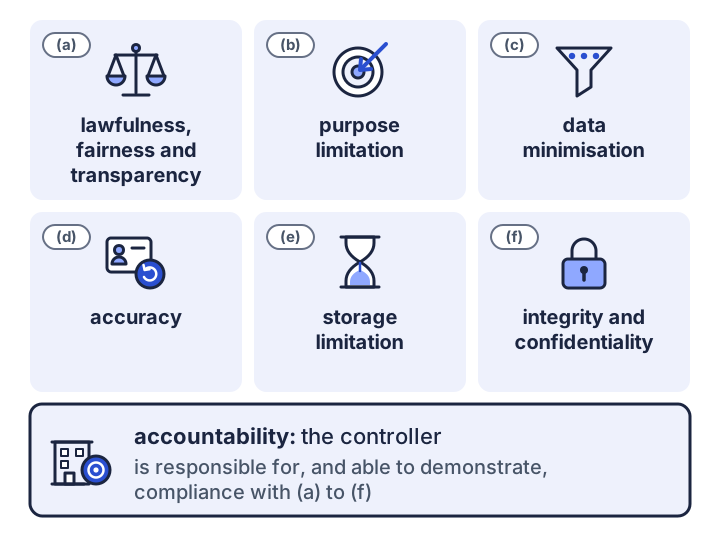
The controller must put in place appropriate measures, chosen in the light of the processing and its risks, to ensure and to be able to demonstrate that processing complies with the Regulation.
-
Data protection by design and default
The controller must build data protection into the processing from the start and, by default, process only the personal data needed for each purpose.
-
Joint controllers
Controllers who jointly determine the purposes and means of processing must set out their responsibilities in an arrangement, and the data subject may exercise his or her rights against each of them.
-
Representative in the Union
A controller or processor not established in the Union whose processing falls under Article 3(2) must designate in writing a representative in the Union, with two exceptions.
-
Contract with a processor
The controller may use only processors with sufficient guarantees, under a written contract or other legal act that binds the processor to the points of Article 28(3).
-
Only on the controller's instructions
The processor and anyone with access to personal data under the authority of the controller or processor must not process those data except on the controller's instructions, unless the law requires it.
-
Records of processing activities
Controllers and processors must keep a written record of their processing and show it to the supervisory authority on request; the exception for those employing fewer than 250 persons does not apply in three cases.
-
Security of processing
The controller and the processor must implement appropriate technical and organisational measures to ensure a level of security appropriate to the risk.
-
Notifying a breach to the authority
The controller must notify a personal data breach to the supervisory authority without undue delay and, where feasible, within 72 hours, unless it is unlikely to result in a risk; a processor must notify the controller.
-
Telling data subjects of a breach
When a personal data breach is likely to result in a high risk, the controller must tell the data subjects without undue delay, unless one of three conditions is met.
-
Data protection impact assessment
Where processing is likely to result in a high risk to the rights and freedoms of natural persons, the controller must carry out a data protection impact assessment before the processing.
-
Prior consultation
Where an impact assessment indicates that the processing would result in a high risk in the absence of measures taken by the controller to mitigate the risk, the controller must consult the supervisory authority before processing.
-
When a DPO is required
The controller and the processor must designate a data protection officer in three cases, and may, or must where Union or Member State law requires, in others.
-
The DPO's position and tasks
The data protection officer must be involved in all data protection issues, receives no instructions on the tasks, reports to the highest management level, and has at least five tasks.
-
Codes of conduct and certification
Associations may draw up codes of conduct for approval by the supervisory authority, and controllers and processors may seek voluntary certification, which does not reduce their responsibility.
Chapter V · Transfers of personal data to third countries or international organisations
-
Three routes for transfers
A transfer of personal data to a third country or an international organisation, and any onward transfer, may take place only on the conditions of Chapter V: an adequacy decision, failing that appropriate safeguards, failing both a derogation for a specific situation.
-
Adequacy decisions
Where the Commission has decided that a third country, a territory or sector in it, or an international organisation ensures an adequate level of protection, personal data may be transferred there without any specific authorisation.
-
Appropriate safeguards
Without an adequacy decision, a controller or processor may transfer personal data only with appropriate safeguards and where enforceable rights and effective legal remedies are available to data subjects; some safeguards need no specific authorisation, others need the supervisory authority's.
-
Orders from third countries
A judgment or decision of a third country's court or authority requiring a controller or processor to transfer or disclose personal data may be recognised or enforced only if it is based on an international agreement in force with the Union or a Member State.
-
Derogations for specific situations
Without an adequacy decision or appropriate safeguards, a transfer may take place only on one of seven conditions, such as the data subject's explicit consent after being informed of the risks or necessity for a contract or for legal claims.
-
Transfers on compelling legitimate interests
Where no other ground of Chapter V applies, a transfer may take place only if it is not repetitive, concerns a limited number of data subjects, is necessary for compelling legitimate interests not overridden, and the controller has assessed the circumstances and provided suitable safeguards.
Chapter VI · Independent supervisory authorities
-
Independent supervisory authorities
Each supervisory authority acts with complete independence: its members take no instructions from anybody, and each Member State must give it the resources, staff and budgets it needs.
-
Powers of supervisory authorities
Each supervisory authority has all the investigative, corrective, and authorisation and advisory powers of Article 58, subject to appropriate safeguards, including effective judicial remedy and due process.
Chapter VII · Cooperation and consistency
-
Lead authority for cross-border processing
For cross-border processing, the authority of the main or single establishment leads, drafts the decision with the other authorities concerned and, failing agreement, refers the matter to the consistency mechanism.
-
The consistency mechanism
Through the consistency mechanism the Board gives opinions on listed draft measures and settles disputes between supervisory authorities by binding decisions; in urgent cases an authority may act provisionally.
-
The European Data Protection Board
The Board brings together the heads of the supervisory authorities and the European Data Protection Supervisor, acts independently and ensures the consistent application of the Regulation.
Chapter VIII · Remedies, liability and penalties
-
Complaint to a supervisory authority
A data subject who considers that processing of his or her data infringes the Regulation may complain to a supervisory authority, which must keep him or her informed.
-
Judicial remedies
Decisions of a supervisory authority, and its failure to handle a complaint, can be challenged in court; a data subject can also sue a controller or processor, in some cases at home.
-
Representation by a not-for-profit body
A data subject may mandate a qualifying not-for-profit body to complain and go to court for him or her; Member States may also let such bodies act without a mandate.
-
Compensation and liability
Anyone who suffers damage from an infringement may claim compensation from the controller or processor; a processor is liable only for its own failures, and whoever proves it is in no way responsible is exempt.
-
Fine ceilings and the factors
Which infringements fall under the lower and which under the higher fine ceiling, and the factors the supervisory authority weighs when deciding whether to fine and how much.
-
Other penalties set by Member States
Member States set other penalties for infringements of the Regulation, in particular those not covered by administrative fines; they must be effective, proportionate and dissuasive.